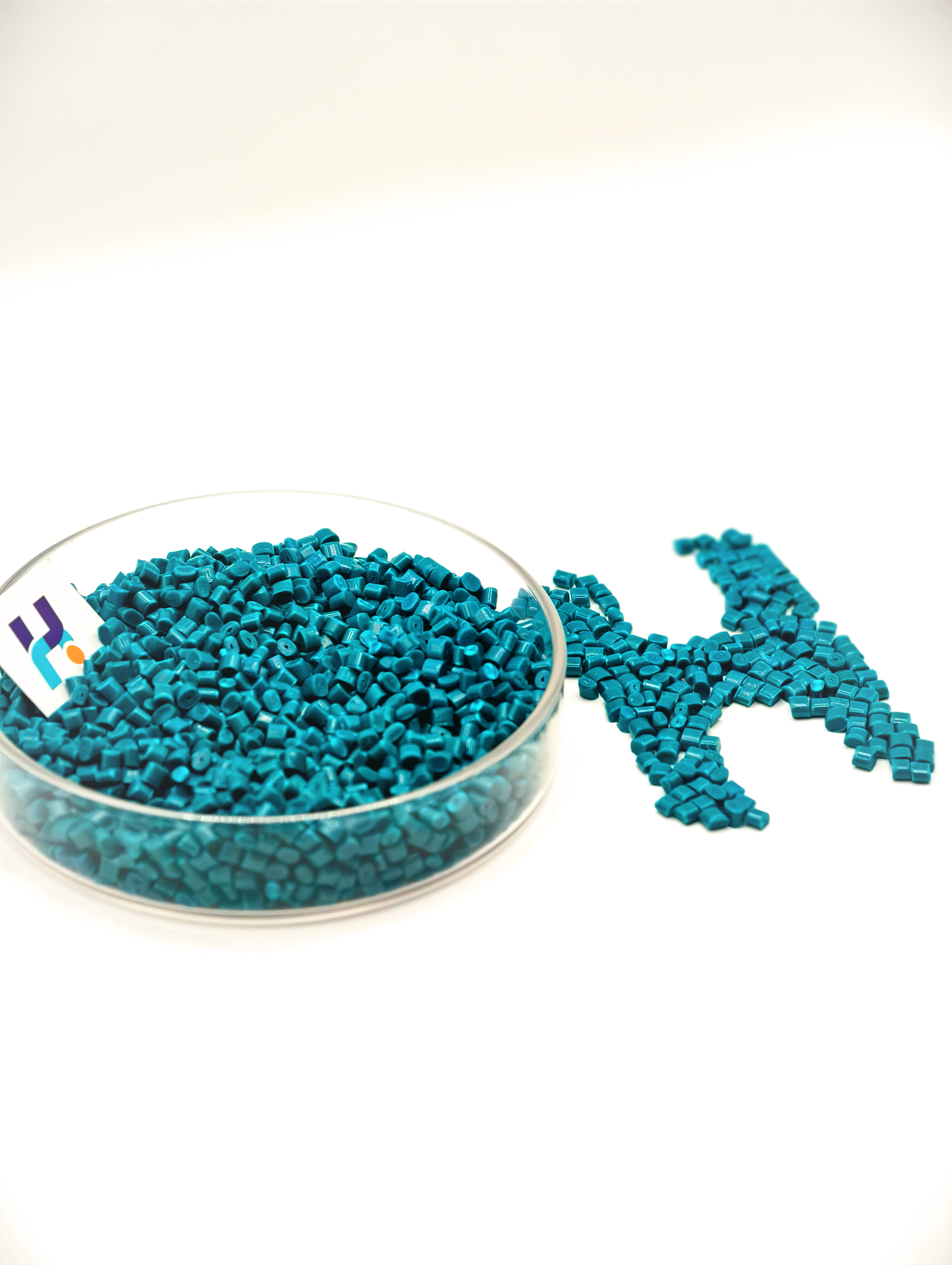
Mineral Reinforced PBT – MF Grade
Precision Stability for Structural & Electrical Applications

Mineral Reinforced PBT is engineered to meet the growing demand for high dimensional accuracy, surface consistency, and thermal stability in modern manufacturing. Unlike glass fiber reinforced grades that prioritize strength, mineral-filled PBT focuses on rigidity, shape retention, and low anisotropy, making it especially suitable for components where flatness, tight tolerances, and appearance are critical.
Positioned between unfilled PBT and glass fiber reinforced PBT, mineral reinforced grades provide a balanced engineering solution—enhancing stiffness and stability without introducing fiber-related surface roughness or excessive directional shrinkage. This makes mineral reinforced PBT an ideal choice for precision housings, electrical components, automotive interiors, and appliance parts produced through high-volume injection molding.
Material Composition & Mineral Reinforcement Structure
 |
 |
Mineral Reinforced PBT is formulated by dispersing finely controlled inorganic mineral fillers—such as talc or calcium-based compounds—uniformly within the PBT polymer matrix. These minerals act as rigid, isotropic reinforcement elements, reducing polymer mobility during cooling and significantly improving dimensional consistency.
Material Composition Overview
-
Base Polymer: Polybutylene Terephthalate (PBT)
-
Reinforcement Type: Inorganic mineral filler
-
Typical Mineral Content: 10%–40% (customizable)
-
Additive Options:
-
Heat stabilizer
-
Flame retardant (V2 / V0)
-
UV stabilizer
-
Anti-hydrolysis package
-
-
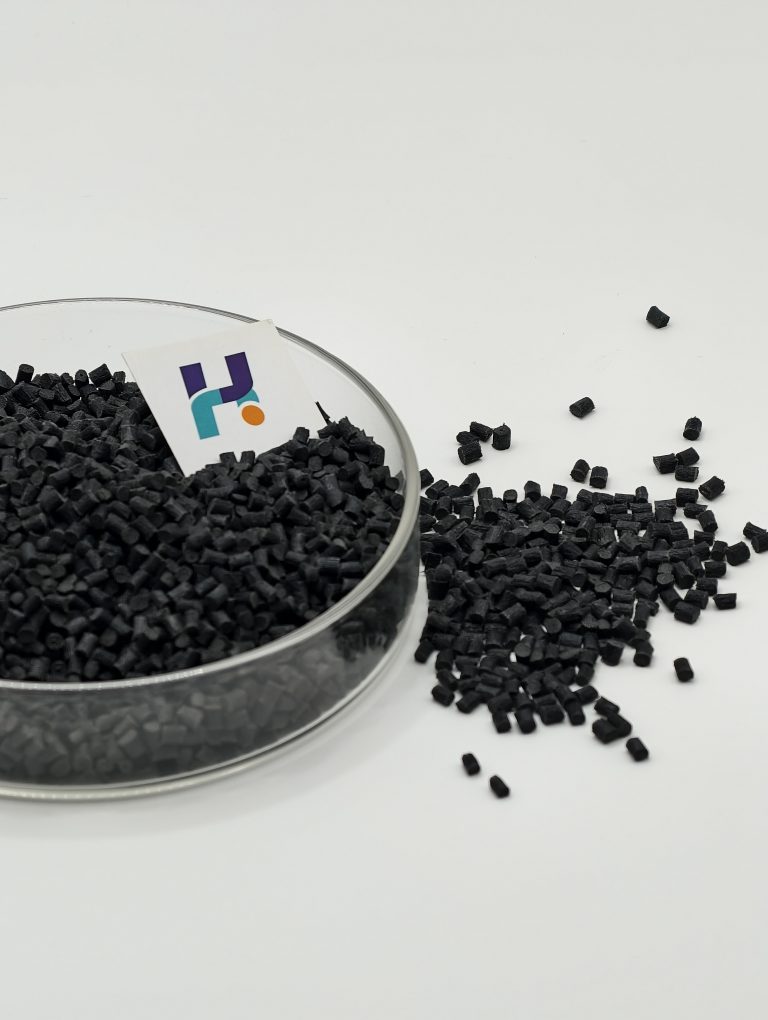
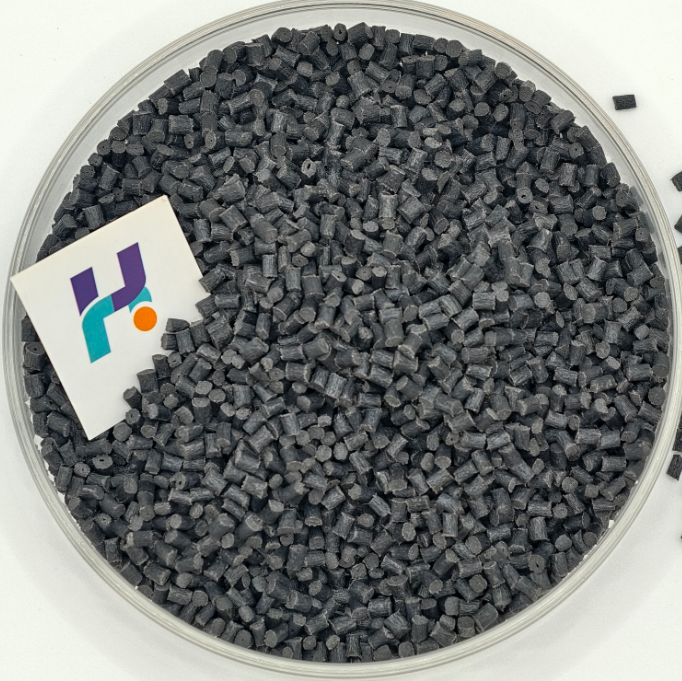
Color Options: Natural, black, custom colors
Unlike glass fibers, mineral fillers introduce minimal fiber orientation, which translates into uniform shrinkage behavior and improved flatness across complex geometries.
Core Material Advantages: Engineering Precision Meets Commercial Efficiency
Mineral reinforced PBT is designed for manufacturers who prioritize precision, consistency, and visual quality as much as mechanical performance.
Engineering Advantages
Exceptional Dimensional Stability
Mineral fillers significantly reduce post-mold deformation, ensuring parts retain their designed geometry over time and across temperature variations.
Low Shrinkage & Minimal Warpage
Shrinkage is reduced and more uniform compared to both unfilled and glass fiber reinforced PBT, making this material ideal for flat or thin-walled parts.
High Rigidity with Isotropic Behavior
The mineral structure increases flexural modulus without creating strong directional properties, resulting in predictable performance regardless of part orientation.
Thermal Stability
Mineral reinforced PBT maintains shape integrity under elevated temperatures, with improved heat distortion resistance suitable for electrical and automotive environments.
Excellent Electrical Insulation
The mineral-filled matrix preserves PBT’s inherent electrical properties, supporting stable insulation performance.
Commercial & Manufacturing Advantages
Superior Surface Appearance
No visible glass fiber exposure, enabling smooth surfaces suitable for visible components or secondary finishing.
Tool-Friendly Processing
Lower mold wear compared to glass fiber grades, reducing long-term tooling maintenance costs.
Consistent High-Volume Production
Stable flow behavior and reduced sensitivity to processing variations improve yield and reduce scrap rates.
Cost-Effective Alternative to GF Grades
Provides rigidity and stability without the cost and surface drawbacks of glass fiber reinforcement.
Typical Application Areas
|
|
|
|


Mineral reinforced PBT is widely used in applications where precision and appearance are as important as mechanical reliability.
Automotive Applications
-
Interior trim brackets
-
HVAC air outlet components
-
Sensor housings
-
Structural panels requiring flatness
-
Cable management parts
Mineral reinforced PBT offers excellent shape stability for interior automotive components exposed to thermal cycling.
Electrical & Electronics
-
Switch housings
-
Terminal blocks
-
Relays and contactor housings
-
Coil bobbins
Its stable electrical insulation and low warpage are ideal for precision electrical assemblies.
Home Appliances
-
Control panel frames
-
Structural shells
-
Motor support brackets
-
Heat-resistant housings
The material ensures long-term dimensional integrity even under repeated heating and cooling cycles.
Industrial & Precision Parts
-
Equipment covers
-
Structural plates
-
Mounting components
Where flatness and tolerance control are critical, mineral reinforced PBT excels.
Processing Performance & Injection Molding Guidelines
Mineral reinforced PBT retains the excellent processability typical of PBT while offering improved molding stability.
Typical Processing Parameters
-
Melt Temperature: 240–260°C
-
Mold Temperature: 60–100°C
-
Drying: 120°C for 3–4 hours
-
Injection Speed: Medium
-
Shrinkage: 0.2–0.5%
Its predictable flow and low anisotropy simplify mold design and improve consistency across multi-cavity tools.
OEM / ODM Customization Options
Mineral reinforced PBT can be precisely tailored to match application-specific requirements.
Customization Capabilities
-
Mineral content adjustment (MF10–MF40)
-
Flame retardant grades (UL94 V2 / V0)
-
Enhanced heat resistance
-
Improved hydrolysis resistance
-
Color matching and surface optimization
-
Electrical performance tuning
OEM Support Services
-
Application-based material selection
-
Performance benchmarking against existing materials
-
Sample formulation and validation
-
Stable long-term supply for mass production
Each formulation is engineered to deliver consistent results in real-world applications.
Technical Specification – Mineral Reinforced PBT
| Property | Test Standard | Typical Value |
|---|---|---|
| Density | ISO 1183 | 1.45–1.65 g/cm³ |
| Tensile Strength | ISO 527 | 55–75 MPa |
| Flexural Strength | ISO 178 | 90–120 MPa |
| Flexural Modulus | ISO 178 | 3,000–5,000 MPa |
| Notched Izod Impact | ISO 180 | 3–6 kJ/m² |
| Heat Deflection Temp. | ISO 75 | 170–210°C |
| Shrinkage | — | 0.2–0.5% |
| Electrical Insulation | — | Excellent |
FAQ
Q1: What is the main advantage of mineral reinforced PBT?
It offers superior dimensional stability, low warpage, and smooth surface quality compared to glass fiber reinforced grades.
Q2: How does mineral reinforced PBT compare to GF PBT?
Mineral reinforced PBT focuses on rigidity and stability rather than tensile strength, with better surface appearance and isotropic behavior.
Q3: Is it suitable for electrical applications?
Yes. It maintains excellent electrical insulation and dimensional accuracy.
Q4: Can flame-retardant versions be provided?
Yes. UL94 V2 and V0 grades are available upon request.
Q5: Can the mineral content be customized?
Absolutely. Mineral loading can be adjusted to match performance and cost requirements.