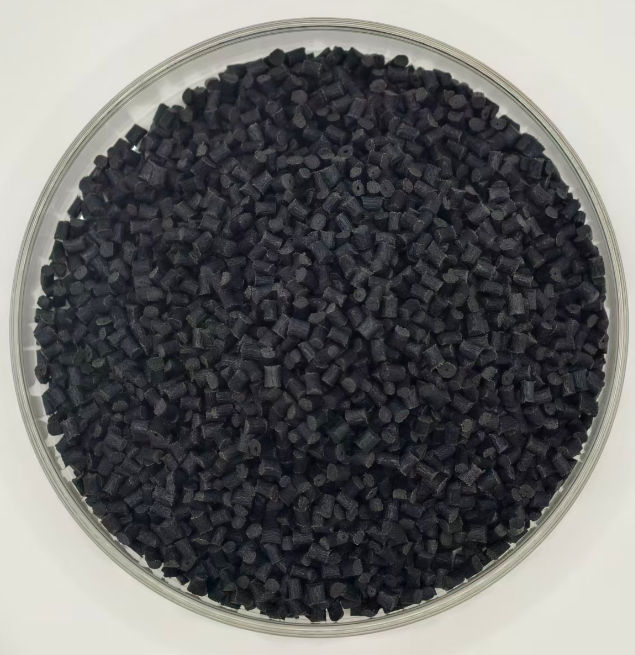
PA6 Glass Fiber Reinforced Materials – Series Overview
Glass fiber reinforced PA6 (Nylon 6) compounds are widely used engineering thermoplastics designed to improve the mechanical performance of standard PA6. By increasing glass fiber content, material stiffness, strength, and dimensional stability are progressively enhanced.
The PA6 GF series provides a structured material upgrade path:
-
GF15 → moderate reinforcement, balanced toughness
-
GF25 → structural-grade strength and stability
-
GF35 → high-rigidity, heavy-load performance
This makes the series ideal for OEMs seeking cost-effective performance scaling without changing base polymer systems.
 |
 |
 |
Glass Fiber Content & Engineering Impact
Glass fiber content directly affects the mechanical behavior of PA6:
-
Higher GF levels increase tensile and flexural modulus
-
Dimensional stability improves as shrinkage decreases
-
Load-bearing capacity and creep resistance increase
-
Impact strength may trade off slightly at very high GF levels
Understanding these relationships is essential for proper material selection.
PA6 GF Series Comparison Table
| Property / Grade | PA6 GF15 | PA6 GF25 | PA6 GF35 |
|---|---|---|---|
| Glass Fiber Content | 15% | 25% | 35% |
| Rigidity (Modulus) | Medium | High | Very High |
| Tensile Strength | Improved | High | Excellent |
| Dimensional Stability | Improved | Excellent | Outstanding |
| Creep Resistance | Moderate | High | Superior |
| Impact Balance | Best | Balanced | Structural-focused |
| Typical Positioning | Functional parts | Structural parts | Heavy-load / metal replacement |
PA6 GF15 – Balanced Reinforcement for Functional Parts
PA6 GF15 is often the first upgrade from unfilled PA6, offering improved stiffness while maintaining good toughness and processability.
Key Characteristics
-
Improved dimensional stability vs unfilled PA6
-
Good impact performance
-
Easy processing and surface quality
Typical Applications
-
Automotive interior components
-
Electrical housings
-
Appliance functional parts
👉 Best choice when cost control and impact balance are priorities.
PA6 GF25 – Structural-Grade Engineering Plastic
PA6 GF25 represents the most widely used structural reinforcement level, offering a strong balance between rigidity and manufacturability.
Key Characteristics
-
Excellent dimensional stability
-
High mechanical strength
-
Reliable performance in continuous-use environments
Typical Applications
-
Automotive brackets and mounts
-
Electrical connectors and enclosures
-
Industrial structural components
👉 Best choice for dimension-critical structural parts.
PA6 GF35 – High-Rigidity Solution for Heavy Loads
PA6 GF35 is designed for applications where stiffness, creep resistance, and long-term load stability are critical.
Key Characteristics
-
Very high rigidity and modulus
-
Outstanding dimensional control
-
Suitable for metal replacement in many designs
Typical Applications
-
Engine bay structural supports
-
Load-bearing industrial components
-
Reinforced appliance frames
👉 Best choice for high-load or metal-replacement designs.
Selection Guide – Which PA6 GF Grade Should You Choose?
| Design Requirement | Recommended Grade |
|---|---|
| Improved stiffness over PA6 | PA6 GF15 |
| Structural strength & stability | PA6 GF25 |
| Heavy load / creep resistance | PA6 GF35 |
| Metal replacement target | PA6 GF35 |
| Cost-sensitive functional parts | PA6 GF15 |
This step-up selection logic allows OEMs to upgrade performance without redesigning the entire material system.
OEM Customization Across the PA6 GF Series
All PA6 GF grades can be tailored to OEM-specific needs, including:
-
Glass fiber content adjustment
-
Heat stabilization
-
Flame-retardant options
-
Color matching
-
Application-specific mechanical tuning
This enables manufacturers to align material performance precisely with product requirements and market regulations.
Commercial & Engineering FAQ
Q1: Can PA6 GF grades replace metal components?
A1: PA6 GF25 and especially GF35 are commonly used for lightweight metal replacement when design conditions allow.
Q2: Does higher glass fiber content always mean better performance?
A2: Not always. Higher GF increases stiffness but may reduce impact toughness. Selection should match application needs.
Q3: Are PA6 GF grades compatible with standard injection molding?
A3: Yes. All grades are designed for processing on conventional injection molding equipment.
Q4: Can OEM formulations be customized within the same GF level?
A4: Yes. Mechanical, thermal, and regulatory properties can be fine-tuned per project.
Strategic Value of the PA6 GF Series
By offering PA6 GF15, GF25, and GF35 within a unified product family, OEM manufacturers gain:
-
Scalable performance options
-
Reduced qualification complexity
-
Easier supplier consolidation
-
Improved long-term cost control
This makes the PA6 GF series a strategic material platform for automotive, electrical, and industrial applications.