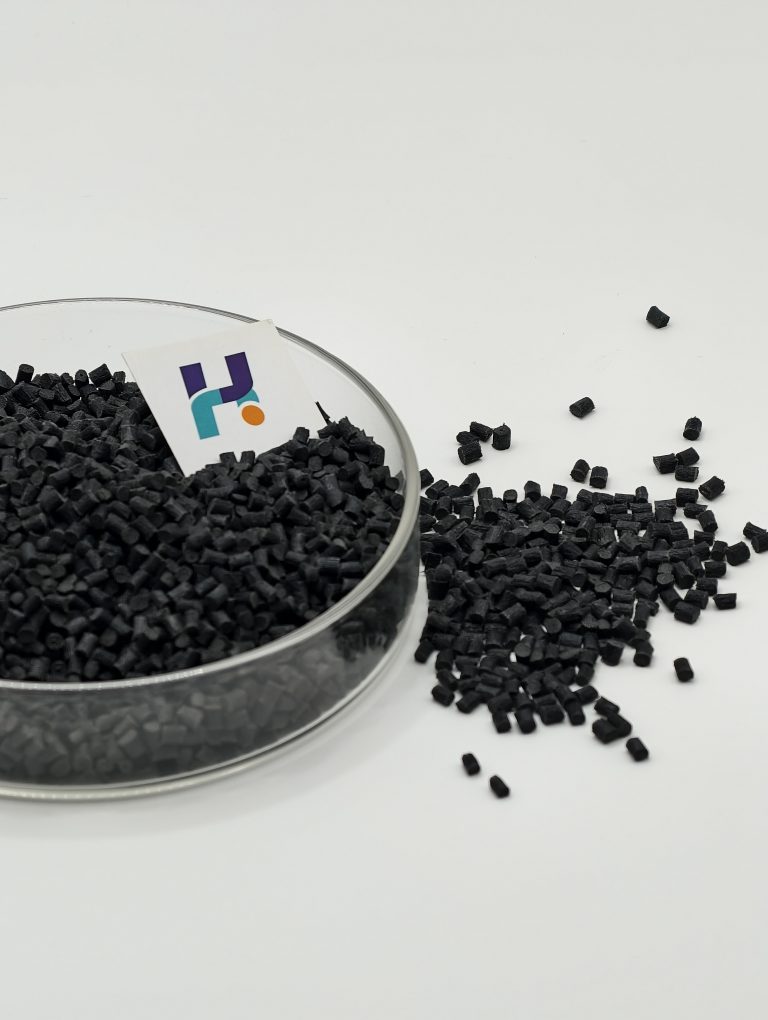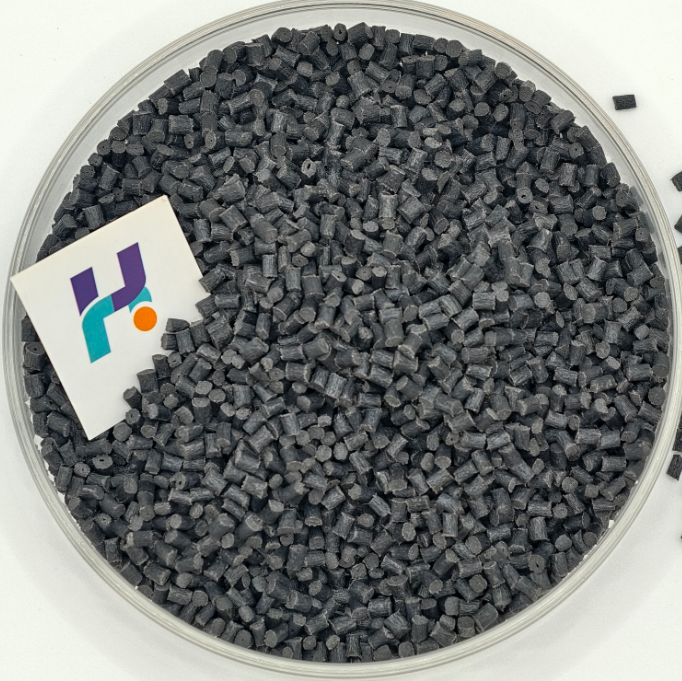
Glass Fiber Reinforced PP GF20
20% Glass Fiber Reinforced Polypropylene for Higher Structural Demands
PP GF20 is developed for applications where PP GF15 reaches its mechanical limit. By increasing the glass fiber content to 20%, this grade significantly enhances rigidity, creep resistance, and long-term dimensional stability, making it suitable for parts exposed to continuous load, thermal cycling, or assembly stress.
Compared with PP GF15, GF20 sacrifices a small amount of toughness in exchange for more predictable structural behavior. Compared with nylon-based materials, PP GF20 still maintains advantages in weight reduction, moisture resistance, and chemical stability.
Material Composition & Reinforcement Strategy
PP GF20 is compounded with a higher concentration of short glass fibers, forming a more rigid internal framework within the polypropylene matrix. This structure limits molecular chain movement under load, resulting in improved resistance to deformation over time.
Material Composition Overview
-
Base Polymer: Polypropylene (PP)
-
Glass Fiber Content: 20% chopped glass fiber
-
Fiber Type: E-glass
-
Optional Additives:
-
Heat stabilizer
-
UV stabilizer
-
Anti-aging additives
-
Processing aids
-
-
Color Options: Natural, black, customized
This formulation shifts PP from a “light structural material” toward a true semi-structural engineering plastic.
Core Advantages: Rigidity, Creep Control & Stability
Engineering Advantages
Higher Structural Rigidity
20% glass fiber content delivers a noticeable increase in flexural modulus compared to GF15.
Improved Creep Resistance
Better performance under long-term static load, especially in warm environments.
Enhanced Dimensional Control
Lower deformation after molding and during service life.
Excellent Chemical Resistance
Maintains PP’s resistance to acids, alkalis, detergents, and automotive fluids.
Low Moisture Sensitivity
Mechanical properties remain stable in humid or wet environments.
Manufacturing & Commercial Advantages
Designed for Load-Bearing PP Parts
Suitable when unfilled PP or GF15 shows deformation during use.
Predictable Performance in Mass Production
More consistent part geometry across production batches.
Cost-Controlled Alternative to Nylon
Offers sufficient stiffness without the weight and moisture issues of PA materials.
Reduced Wall Thickness Potential
Higher stiffness allows thinner designs in certain structures.
Typical Application Areas
Automotive Applications
-
Structural brackets
-
Battery module supports
-
Underbody covers with load requirement
Home Appliances
-
Internal frames
-
Load-bearing supports
-
Structural reinforcement parts
Industrial Equipment
-
Equipment housings
-
Mechanical support components
-
Structural plastic frames
|
|
|
|


Processing Performance & Injection Molding Guidelines
Typical Processing Parameters
-
Melt Temperature: 210–250°C
-
Mold Temperature: 40–70°C
-
Drying: Not required under normal storage
-
Injection Speed: Medium
-
Shrinkage: 0.4–0.7% (directional)
Proper gate design and flow direction control help optimize fiber orientation.
OEM / ODM Customization Capabilities
Customization Options
-
Glass fiber content: GF15 / GF20 / GF25
-
UV-resistant outdoor grades
-
Heat-stabilized formulations
-
Improved surface appearance grades
-
Color customization
OEM Support Services
-
Structural performance evaluation
-
Material selection comparison (GF15 vs GF20)
-
Prototype sampling
-
Long-term supply assurance
Technical Specification – PP GF20
| Property | Test Standard | Typical Value |
|---|---|---|
| Density | ISO 1183 | 1.10–1.15 g/cm³ |
| Tensile Strength | ISO 527 | 65–80 MPa |
| Flexural Strength | ISO 178 | 95–120 MPa |
| Flexural Modulus | ISO 178 | 4,200–5,200 MPa |
| Notched Izod Impact | ISO 180 | 3–5 kJ/m² |
| Heat Deflection Temp. | ISO 75 | 140–160°C |
| Shrinkage | — | 0.4–0.7% |
| Chemical Resistance | — | Excellent |
FAQ
Q1: Why choose PP GF20 instead of PP GF15?
When higher stiffness and better creep resistance are required under long-term load.
Q2: Does PP GF20 replace nylon materials?
In many medium-load applications, yes—especially where moisture resistance and weight reduction matter.
Q3: Is PP GF20 suitable for large parts?
Yes, particularly for large components that need better shape retention than GF15.
Q4: Does higher glass fiber reduce impact strength?
Slightly, but the trade-off improves structural predictability and stability.
Q5: Can PP GF20 be customized?
Yes. Fiber content, UV resistance, heat stability, and color can be adjusted.