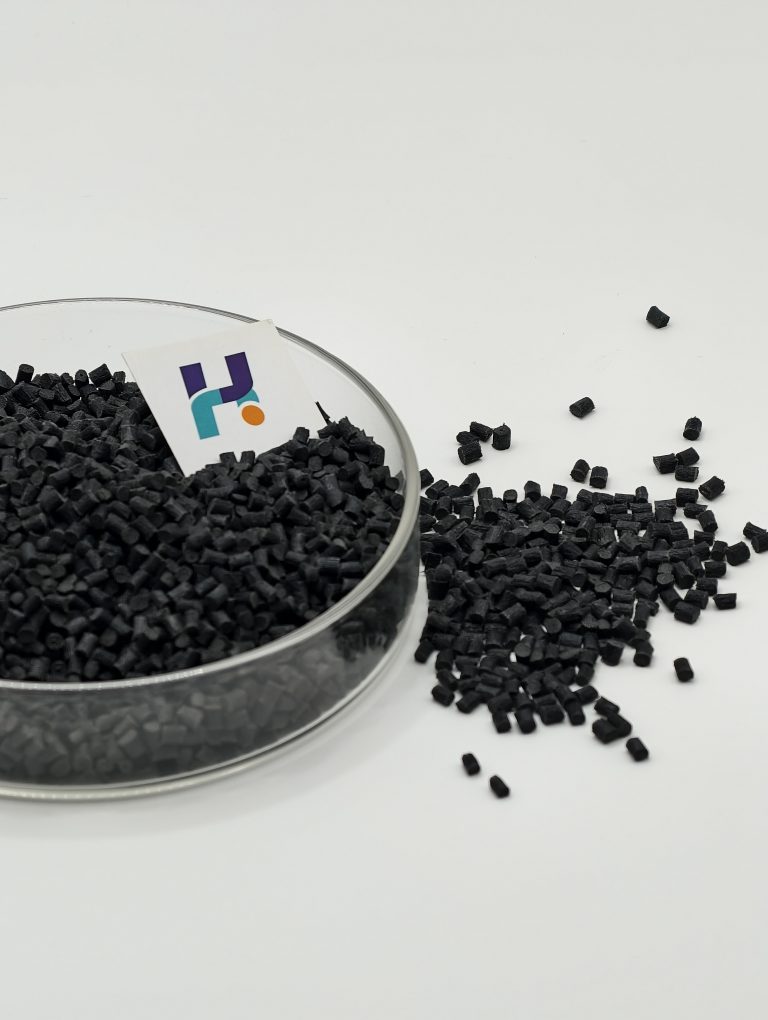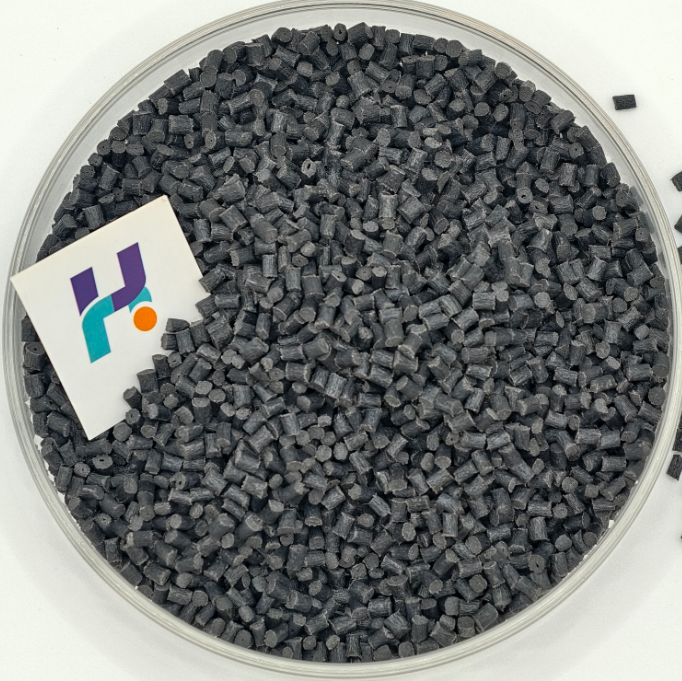
Glass Fiber Reinforced Polyoxymethylene (POM)
Structural Acetal for High-Stiffness & Precision Components
Glass Fiber Reinforced POM is developed for applications where standard POM’s stiffness and load resistance are insufficient. By introducing short glass fibers into the acetal matrix, this material achieves a substantial increase in flexural modulus, creep resistance, and dimensional stability, while still retaining POM’s inherent precision characteristics.
Compared with standard POM, this grade offers much higher rigidity. Compared with glass fiber reinforced PA, it provides lower moisture absorption and more predictable tolerances, making it suitable for dimension-critical structural parts.
Material Composition & Glass Fiber Reinforcement Strategy
Material Composition Overview
-
Base Polymer: Polyoxymethylene (POM / Acetal)
-
Reinforcement Type: Short glass fiber
-
Typical Fiber Content: 10–30% (grade dependent)
-
Optional Additives:
-
Heat stabilizers
-
Impact modifiers
-
Lubrication modifiers
-
UV stabilizers
-
-
Color Options: Natural, black, customized
This formulation prioritizes structural integrity over friction optimization.
Core Advantages: Rigidity, Load Control & Stability
Engineering Advantages
Significantly Increased Stiffness
Glass fiber reinforcement dramatically increases flexural modulus.
Improved Load-Bearing Capacity
Better resistance to deformation under static and dynamic loads.
Enhanced Dimensional Stability
Lower creep and reduced thermal deformation.
Low Moisture Absorption
Maintains tight tolerances even in humid environments.
Good Chemical Resistance
Resistant to fuels, oils, solvents, and industrial chemicals.
Manufacturing & Commercial Advantages
Precision Injection Molding
Consistent part geometry with predictable shrinkage behavior.
Structural Reliability
Stable mechanical performance across production batches.
Long Service Life
Reduced deformation leads to extended functional lifespan.
Alternative to Glass Fiber PA
Offers stiffness with better moisture stability.
Typical Application Areas
Automotive Components
-
Structural brackets
-
Reinforced housings
-
Precision load-bearing parts
Industrial Equipment
-
Structural supports
-
Mechanical frames
-
High-precision structural components
Electrical & Mechanical Assemblies
-
Precision structural elements
-
Functional housings with load requirement
|
|
|
 housings with load requirement housings with load requirement |


Processing Performance & Injection Molding Guidelines
Typical Processing Parameters
-
Melt Temperature: 195–220°C
-
Mold Temperature: 80–110°C
-
Drying: 80°C for 2–4 hours
-
Injection Speed: Medium
-
Shrinkage: 1.3–1.8% (directional)
Gate design and fiber orientation control are important for optimal performance.
OEM / ODM Customization Capabilities
Customization Options
-
Glass fiber content levels
-
Heat-stabilized grades
-
Impact-modified formulations
-
Surface-optimized grades
-
Color customization
OEM Support Services
-
Structural performance evaluation
-
Material selection guidance
-
Prototype sampling
-
Long-term supply assurance
Technical Specification – Glass Fiber Reinforced POM (Typical)
| Property | Test Standard | Typical Value |
|---|---|---|
| Density | ISO 1183 | 1.45–1.55 g/cm³ |
| Tensile Strength | ISO 527 | 70–95 MPa |
| Flexural Strength | ISO 178 | 110–140 MPa |
| Flexural Modulus | ISO 178 | 4,000–7,000 MPa |
| Notched Izod Impact | ISO 180 | 4–7 kJ/m² |
| Heat Deflection Temp. | ISO 75 | 160–180°C |
| Moisture Absorption | — | Very Low |
| Dimensional Stability | — | Excellent |
FAQ
Q1: How does glass fiber reinforced POM differ from standard POM?
It provides much higher stiffness and load resistance with reduced deformation.
Q2: Is glass fiber reinforced POM suitable for moving parts?
It is best for structural or lightly moving parts where rigidity is prioritized.
Q3: How does it compare to glass fiber reinforced PA?
POM offers lower moisture absorption and more stable dimensions.
Q4: Does glass fiber reduce impact resistance?
Slightly, but the trade-off delivers improved structural predictability.
Q5: Can glass fiber reinforced POM be customized?
Yes. Fiber content and mechanical balance can be tailored.