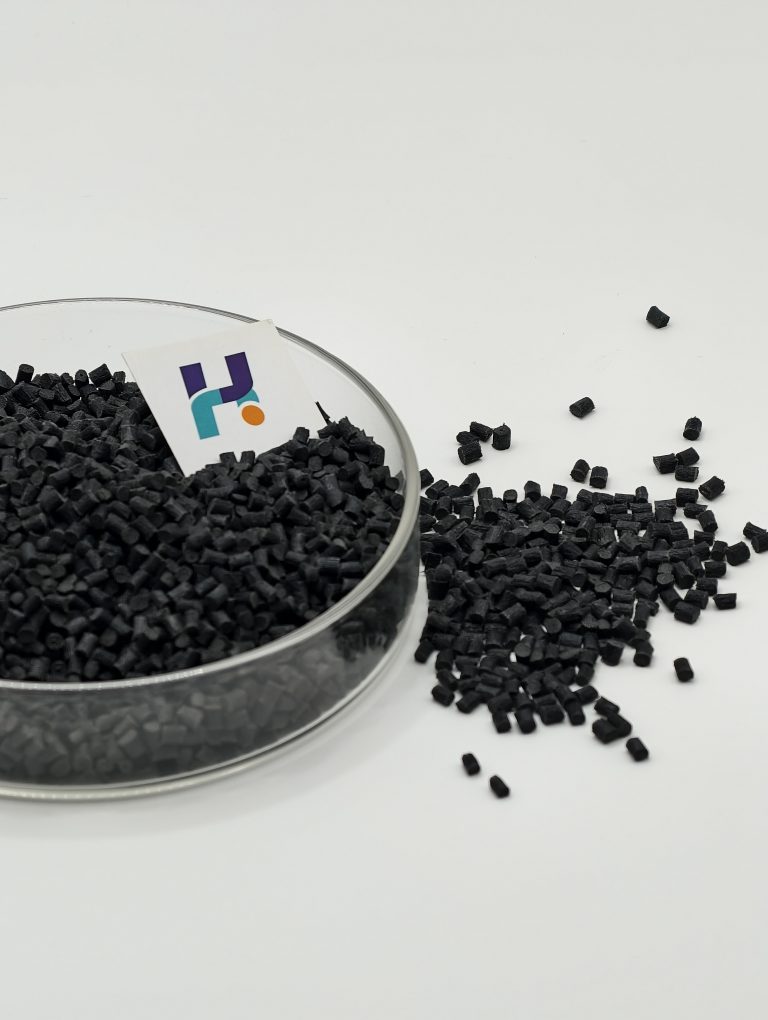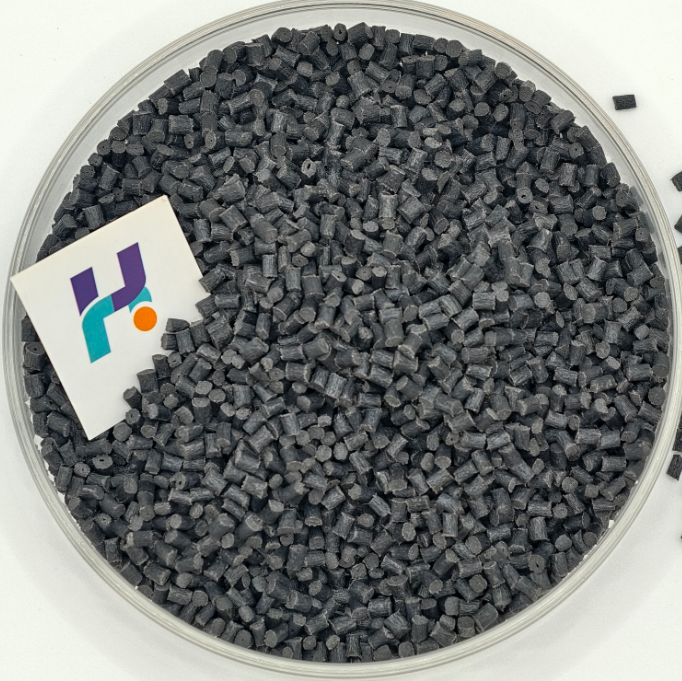
PA6 GF40 is selected when structural limits are reached and deformation must be minimized under continuous load.
However conventional PA6 GF40 materials introduce a new set of risks:
-
Surface floating fibers after molding
-
Poor surface integrity in contact areas
-
Increased wear on mating components
-
Handling discomfort and quality complaints
-
Unstable appearance and coating adhesion issues
Our no-floating-fiber PA6 GF40 is designed to remove these secondary risks while maintaining extreme stiffness.
At 40% glass fiber, surface quality is no longer optional — it directly affects reliability.
Material Composition & Controlled Fiber Strategy
Unlike standard GF40 formulations, our PA6 GF40 uses a fiber dispersion and wet-out control system that keeps glass fibers embedded within the polymer matrix, rather than breaking through the surface during flow and packing.
Material Overview
-
Base Polymer: Polyamide 6 (Nylon 6)
-
Glass Fiber Content: 40%
-
Fiber Type: Optimized short glass fiber
-
Key Feature: No floating fiber surface
-
Optional Additives:
-
Heat stabilizers
-
Hydrolysis resistance packages
-
Processing lubricants
-
Color concentrates
-
-
Colors: Natural, black, customized
This formulation prioritizes structural dominance and surface integrity.
Core Performance Advantages
Structural Advantages
Extreme Structural Stiffness
Very high flexural modulus limits bending and torsional deformation even under sustained load.
Excellent Load Retention
Maintains geometry in long-term static and dynamic stress conditions.
Low Creep at Elevated Temperatures
Suitable for metal-replacement designs with tight deformation limits.
Surface & Manufacturing Advantages
No Floating Fiber on Surface
Eliminates exposed glass fibers after molding.
Improved Assembly Safety
No fiber protrusion at contact or fastening zones.
Reduced Abrasion of Mating Parts
Protects seals, cables, and adjacent plastic components.
Better Coating, Painting & Label Adhesion
Cleaner surface improves secondary processing reliability.
More Consistent Visual Quality
Especially important for semi-visible structural parts.
Standard GF40 focuses on stiffness only.
Our GF40 focuses on stiffness and usability.
Typical Application Areas
Automotive & Transportation
-
Structural brackets
-
Pedal carriers
-
Under-hood load frames
Chosen when GF30 deforms and surface fiber exposure cannot be accepted.
Industrial & Mechanical Equipment
-
Structural arms
-
Support frames
-
Heavy-duty housings
Used where operators handle parts directly.
Electrical & Energy Systems
-
Structural carriers
-
Reinforcement frames
-
Alignment-critical components
Ideal when surface contact safety and insulation interfaces matter.
Processing Guidelines
Our PA6 GF40 maintains a stable processing window despite high fiber loading.
Typical Processing Parameters
-
Melt Temperature: 260–290 °C
-
Mold Temperature: 80–110 °C
-
Drying: 80–90 °C / 4–6 hours
-
Injection Speed: Medium
-
Shrinkage: ~0.2–0.5% (directional)
Proper gate design further enhances surface quality by stabilizing fiber orientation near the mold wall.
OEM & Customization Support
Customization Options
-
Heat-stabilized grades
-
Enhanced hydrolysis resistance
-
Fiber length and dispersion tuning
-
Color matching
OEM Support
-
GF30 vs GF40 structural selection
-
Surface quality validation
-
Assembly compatibility testing
-
Long-term supply stability
Typical Technical Data
| Property | Test Standard | Typical Value |
|---|---|---|
| Density | ISO 1183 | 1.45–1.50 g/cm³ |
| Tensile Strength | ISO 527 | 180–210 MPa |
| Flexural Strength | ISO 178 | 260–320 MPa |
| Flexural Modulus | ISO 178 | 13,000–16,000 MPa |
| Notched Izod Impact | ISO 180 | 5–8 kJ/m² |
| Heat Deflection Temp. | ISO 75 | 210–225 °C |
| Moisture Absorption | — | Moderate |
FAQ
Q1: What does “no floag fiber” mean in PA6 GF40?
It means glass fibers remain embedded in the polymer matrix and do not protrude from the molded surface.
Q2: Why is floating fiber a problem in high-GF nylon?
Exposed fibers can cause abrasion, poor surface quality, handling discomfort, and assembly reliability issues.
Q3: Does removing floating fiber reduce stiffness?
No. Structural stiffness is maintained while surface integrity is improved.
Q4: Is no-floating-fiber PA6 GF40 suitable for metal replacement?
Yes. It delivers extreme stiffness with better surface usability than conventional GF40.
Q5: Does this material require special tooling?
Hardened tooling is recommended, but no additional surface treatment is required.