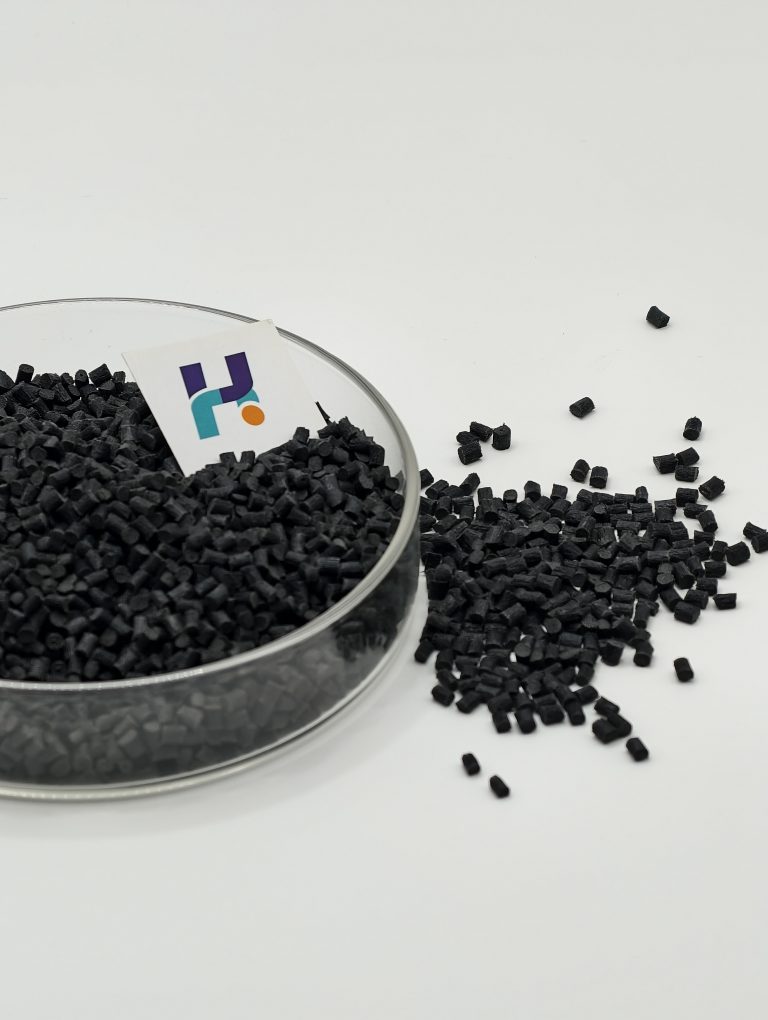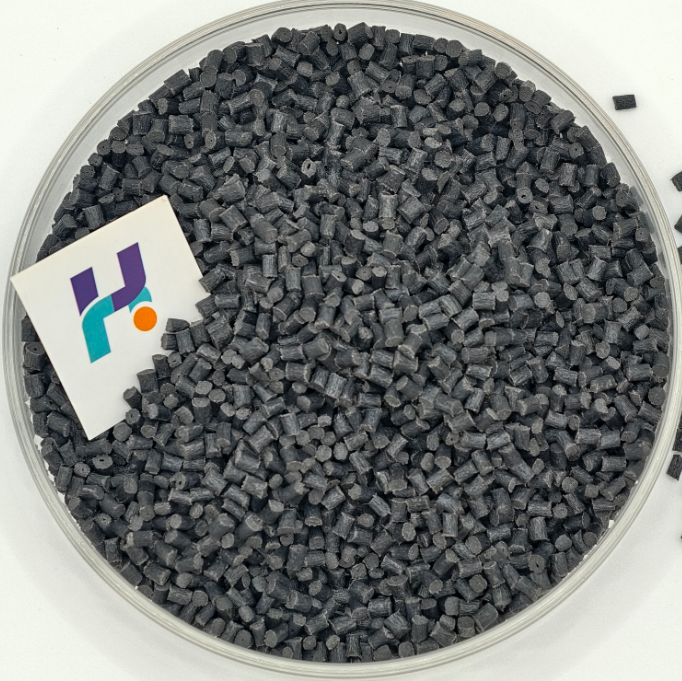
Glass Fiber Reinforced PP GF15
15% Glass Fiber Reinforced Polypropylene for Lightweight Structural Parts
PP GF15 is designed for applications where weight reduction, cost control, and dimensional stability are more important than extreme mechanical strength. By incorporating 15% glass fiber, standard polypropylene gains improved rigidity and reduced thermal expansion, while still retaining PP’s natural advantages such as low density, excellent chemical resistance, and easy processability.
Compared with unfilled PP, GF15 provides a significant upgrade in stiffness and shape stability. Compared with PA6 or PA66 GF grades, PP GF15 offers lower weight, lower moisture absorption, and better chemical resistance, making it a highly practical solution for large-volume molded parts.
Material Composition & Glass Fiber Reinforcement Structure
Glass Fiber Reinforced PP GF15 is produced by compounding short glass fibers uniformly into a polypropylene matrix. The glass fibers enhance load distribution and limit deformation under stress, while the PP base maintains toughness and chemical stability.
Material Composition Overview
-
Base Polymer: Polypropylene (PP)
-
Glass Fiber Content: 15% chopped glass fiber
-
Fiber Type: E-glass
-
Optional Additives:
-
Heat stabilizer
-
UV stabilizer
-
Impact modifier
-
Anti-aging additives
-
-
Color Options: Natural, black, customized
This composition delivers a balanced structural PP, ideal for medium-load components.
Core Advantages: Lightweight, Stability & Chemical Resistance
Engineering Advantages
Lightweight Structure
PP GF15 has a much lower density than PA-based materials, supporting lightweight design.
Improved Stiffness
15% glass fiber reinforcement significantly increases flexural modulus compared to unfilled PP.
Excellent Dimensional Stability
Reduced shrinkage and warpage make it suitable for large and thin-wall parts.
Outstanding Chemical Resistance
Resistant to acids, alkalis, detergents, and automotive fluids.
Low Moisture Absorption
Unlike nylon materials, PP GF15 maintains stable dimensions in humid environments.
Manufacturing & Commercial Advantages
Cost-Effective Reinforcement Level
Delivers structural improvement without high material or processing costs.
Easy Processing
Good flow behavior and low melt viscosity support efficient injection molding.
Large-Part Friendly
Ideal for big components where nylon may be too heavy or costly.
High Production Stability
Consistent molding performance in mass production.
Typical Application Areas
Automotive Applications
-
Interior structural parts
-
Battery trays
-
Air duct components
-
Brackets and supports
Home Appliances
-
Washing machine housings
-
Structural frames
-
Internal support components
Industrial & Logistics Products
-
Equipment housings
-
Utility components
-
Structural plastic parts

Battery trays 
Interior housings 
Structural plastic parts
Processing Performance & Injection Molding Guidelines
Typical Processing Parameters
-
Melt Temperature: 200–240°C
-
Mold Temperature: 30–60°C
-
Drying: Not strictly required (if stored properly)
-
Injection Speed: Medium
-
Shrinkage: 0.5–0.9% (directional)
Compared with nylon materials, PP GF15 requires lower processing temperatures and simpler moisture control.
OEM / ODM Customization Capabilities
Customization Options
-
Glass fiber content: GF10 / GF15 / GF20
-
UV-stabilized outdoor grades
-
Impact-modified formulations
-
Heat-stabilized grades
-
Color customization
OEM Support Services
-
Application-based material selection
-
Prototype sampling
-
Cost-performance optimization
-
Long-term supply assurance
Technical Specification – PP GF15
| Property | Test Standard | Typical Value |
|---|---|---|
| Density | ISO 1183 | 1.05–1.10 g/cm³ |
| Tensile Strength | ISO 527 | 55–70 MPa |
| Flexural Strength | ISO 178 | 80–100 MPa |
| Flexural Modulus | ISO 178 | 3,000–4,000 MPa |
| Notched Izod Impact | ISO 180 | 4–6 kJ/m² |
| Heat Deflection Temp. | ISO 75 | 130–150°C |
| Shrinkage | — | 0.5–0.9% |
| Chemical Resistance | — | Excellent |
FAQ
Q1: What is the main advantage of PP GF15?
It offers a lightweight, cost-effective solution with improved stiffness and dimensional stability.
Q2: How does PP GF15 compare to unfilled PP?
GF15 provides much higher rigidity and lower warpage while maintaining PP’s chemical resistance.
Q3: How does PP GF15 compare to PA6 GF15?
PP GF15 is lighter, absorbs almost no moisture, and is more chemically resistant, while PA6 GF15 offers higher strength.
Q4: Is PP GF15 suitable for large molded parts?
Yes. It is commonly used for large components due to low weight and stable molding behavior.
Q5: Can PP GF15 be customized?
Yes. Fiber content, impact resistance, UV stability, and color can be customized.